 Skip to content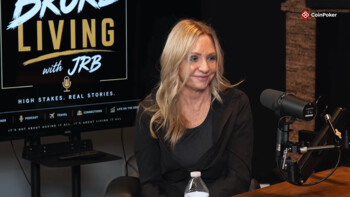
Jennifer Harman has spent decades playing against some of poker’s toughest opponents. In the second episode of Broke Living With JRB, she talks about what that career has actually felt like: long sessions, enormous swings, friendships across the table, and the responsibility of raising a family while making a living from cards. The result is a delightfully informative, genuine, and humorous interview.
The conversation with Jean-Robert Bellande also includes a project away from the felt. Harman says she is writing an autobiography, with poker, her personal life, and the ups and downs of both at its center.
The 2015 Poker Hall of Fame inductee and two-time World Series of Poker bracelet winner is candid about losses and self-doubt. Her reputation is formidable. The conversation reveals the determination, honesty, and sense of humor behind it.
Table of Contents
From Reno to the Biggest Games
Harman recalls playing poker with relatives as a child, then entering Reno casino games at 16 with a fake ID. She started in low-limit stud and moved to limit hold’em, learning through play and home games with dealers rather than strategy books.
She says it took roughly three years to become a winning player. Early on, she did not even understand the significance of the dealer button.
A move to Los Angeles brought her to the Bicycle Club. Across from the smaller game she was playing sat the bigger game she wanted to join, with players including Doyle Brunson, Chip Reese, and Johnny Chan.
One early shot involved learning the basics of ace-to-five lowball so she could play in a game with Frank Mariani and Jerry Buss. Harman remembers winning about $20,000 that night, her first major score.
The work was not glamorous. She describes playing roughly 70 hours a week and sometimes checking into a nearby hotel because she was too tired to drive home.
Doyle Brunson, Daniel Negreanu, and Life Across the Table
Bellande opens the episode by remembering Harman in Bobby’s Room alongside Brunson, Chip Reese, Phil Ivey, and other high-stakes regulars. His respect was for her standing in those games, not simply for being a woman playing them.
Harman remembers Brunson as warm and generous away from poker, treating her like a daughter. At the table, he wanted to win.
She describes her friendship with Daniel Negreanu as a brother-and-sister relationship. After watching him win his first bracelet, she says, they became close, spending time together and talking about poker and life.
One trip to the bank produced an unexpected complication. Harman recalls going to Wells Fargo with Negreanu to withdraw approximately $30,000 after running out of money to play with. Bank staff took her aside and asked whether he was kidnapping her and holding her for ransom.
She laughed at the suggestion. The bank eventually gave her the money.
The friendship did not mean going easy on him at cards. Harman says she warned a young Negreanu against sitting in a game too large for his bankroll. Once he sat down, she still tried to win his money. Afterward, she would lend him more.

A $150,000 Decision and a $380,000 Loss
Harman’s high-stakes stories are not all accounts of perfect composure.
In one no-limit deuce-to-seven hand, she recalls standing pat with a seven-low and facing a $150,000 shove from a player she barely knew. She estimates the bet was eight to ten times the pot.
She called and won against an eight-low. Asked whether she studied her opponent, Harman says she was concentrating on breathing.
“I was focusing on trying to breathe as I was trying to decide what I needed to do,” she tells Bellande.
Another recollection concerns a session in which she was down roughly $600,000 to $700,000 before recovering enough to finish with a loss of approximately $380,000. She remembers being delighted with that result compared with where the session had been heading.
The scale of those swings explains why a discussion of high-stakes poker cannot stop at the size of the winning pots. The losses, and knowing when to walk away, are part of the story too.
Harman says she generally quits when losses become too painful. “It’s a lifelong game,” she says.
The Bankroll in Her Purse
The most revealing part of the interview comes when Bellande asks about the difference between a player’s public reputation and financial reality.
Harman recalls times when people assumed she was a multimillionaire while she was carrying her bankroll in her purse. During prolonged losing stretches, she says, she has questioned her ability and considered what else she could do for a living.
Motherhood added another responsibility. Harman says raising twins may have made her more driven to play well because other people depended on her.
It also produced an expensive online-poker memory. While one of her sons was an infant sitting on her lap, she recalls him hitting the computer and folding her nut flush. She estimates the pot at around $20,000. Motherhood and online poker do not always make a profitable combination.
When Bellande discusses finding more time for his own children, Harman encourages him to do it. The years go quickly, she tells him, even when they do not feel that way at the time.
Women in Poker and the Solver Era
Harman says she did not approach poker feeling she needed to prove herself because she was a woman. She loved the game and wanted to play.
That does not mean she thinks everyone finds the environment welcoming. She supports women’s tournaments as a way to let more women participate comfortably and enjoy poker. She would particularly like to see more women in mixed games.
Her own preference remains cash games. She describes tournaments as emotionally demanding: a player can perform well, take a bad beat, and leave with nothing.
She is also frank about game selection in modern no-limit hold’em. Harman says she avoids the solver-trained “wizards” and prefers a more sociable game. She identifies no-limit deuce-to-seven as her favorite variant and David Oppenheim as her toughest opponent.
An Autobiography, Not a Strategy Manual
Near the end of the episode, Harman says the book she is writing will cover her life, friendships in poker, and difficult periods as well as successes. It will not be a poker strategy book.
“I’m laying it all out there as vulnerable as I can be,” she says.
Asked when it might be ready, she answers, “Probably a year.” She hopes the book will be inspirational, sharing the personal story behind a career most people have seen only from across the table.
Asked how she hopes the poker community will remember her, Harman’s answer is direct: “As a legend.”
Watch the Interview and Follow the Players
Watch Broke Living With JRB, Episode 2: Jennifer Harman.
Follow Jean-Robert Bellande on YouTube and X, and Jennifer Harman on X. Her Wikipedia biography provides additional background.

Leave a Reply